
Planet Optima is a Los Angeles utility rebate implementation partner. It replaces toilets in multifamily buildings (5+ units) at no cost to the owner through LADWP’s commercial rebate, and has installed more than 500,000 rebate toilets across Southern California in 15+ years. The regulatory summaries below are for planning, not legal advice. Check the linked source for anything that affects a decision.
The rules that already carry fines in Los Angeles (the LADWP conservation ordinance, EBEWE reporting, unreasonable water use budgets) are the tools LADWP will lean on to hit its number. This guide separates what applies to suppliers from what applies to you, lists every current requirement with its penalty, and shows the one indoor fix LADWP pays for.
What January 1, 2027 Actually Requires
Short version: the state is regulating LADWP, and LADWP is going to regulate you.
On July 3, 2024, the State Water Resources Control Board adopted Making Conservation a Way of Life, the permanent water efficiency framework that came out of AB 1668 and SB 606. It took effect January 1, 2025. It is not a drought measure. It does not turn off when it rains.
The regulation gives every urban retail water supplier an annual water use objective. That objective is built from four parts:
| Component | Standard | Notes |
|---|---|---|
| Indoor residential use | 47 gallons per person per day (2025 to 2029) | Drops to 42 GPCD on January 1, 2030 |
| Outdoor residential use | Landscape-area based budget | Uses aerial measurements of irrigable area |
| Commercial, industrial, institutional landscape | Dedicated-meter budgets | Applies to CII accounts with irrigation meters |
| Water loss | Supplier-specific leak standard | System losses, not customer use |
Here is the timeline:
| Date | What happens | Who it binds |
|---|---|---|
| January 1, 2025 | Regulation in effect. Suppliers calculate and report objectives. | Suppliers |
| January 1, 2027 | Suppliers begin annual compliance demonstrations against their objectives. | Suppliers |
| January 1, 2030 | Indoor standard tightens to 42 GPCD. | Suppliers |
| Your building | No separate state deadline. | Nobody, directly |
That last row matters. Several vendor and law-firm pages describe January 1, 2027 as a building deadline. It is not. The regulation’s own fact sheet names urban retail water suppliers as the regulated party.
So why does it matter to a 60-unit building in Koreatown?
It matters because LADWP has to hit a number, and multifamily indoor use is a major lever it controls on the customer side. The regulation’s own list of supplier tools reads like a preview of what is coming: rate structures, leak detection, direct-install programs, rebates, enforcement of local ordinances. LADWP already runs all of these. The 2027 date gives it a reason to run them harder.
The indoor standard is the number to remember: 47 gallons per person per day. An apartment with two people, two 1.6 GPF toilets, and one slow flapper leak can burn through that before anyone showers.
Rules That Apply to Your Building Today
These are the requirements that carry penalties for Los Angeles apartment buildings right now. Every one predates the 2027 date, and every one gets more enforcement attention as it approaches.
LADWP Water Conservation Ordinance
LADWP’s Emergency Water Conservation Ordinance has been in force continuously since 2023. The city moves between phases based on supply; the phase in effect is listed on LADWP’s ordinance page, and it was Phase 2 as of September 2026. Core rules apply in every phase:
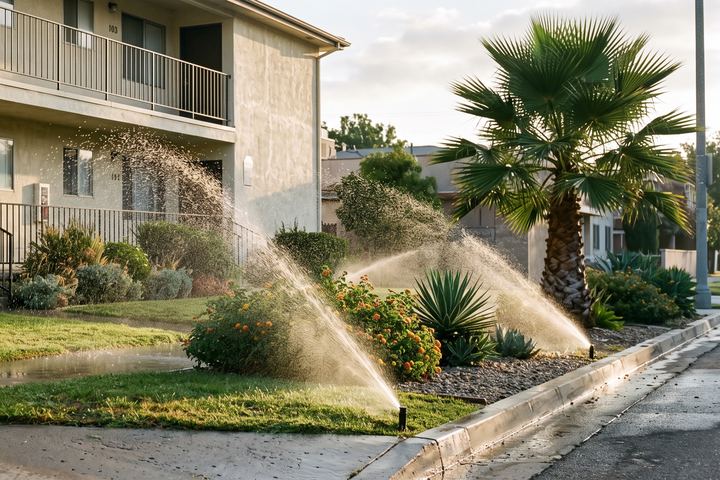
- Outdoor watering is allowed only on assigned days (odd and even street numbers get different days).
- Outdoor watering is not allowed between 9 a.m. and 4 p.m.
- Sprinkler run times are capped per station (8 minutes standard, 15 minutes for water-conserving nozzles).
- Hardscape must not be watered, and water must not run off to the street.
- Leaks must be repaired promptly.
Watering-day rules by street number are covered in LADWP’s conservation rules for apartment buildings.
Penalties for meters two inches and larger (most apartment buildings):
| Violation | Fine |
|---|---|
| First | Written warning |
| Second | $200 |
| Third | $400 |
| Fourth and later | $600 |
Fines post to the water bill. Under the ordinance, an owner may pass up to half of a conservation penalty through to tenants as a temporary surcharge. In practice that creates a tenant-relations problem to go with the fine.
Unreasonable Water Use Amendment
This is the part of the ordinance most owners have never heard of.
LADWP’s Board approved enforcement rules for the unreasonable water use amendment, which targets the city’s highest-tier users. A property flagged for unreasonable use gets an on-site water use analysis from the Water Conservation Response Unit, a property-specific water budget, and a Customer Conservation Plan listing required actions.
Miss the plan, and penalties start:
| Phase | Monthly penalty for noncompliance |
|---|---|
| Phase 2 | $1,000, rising to $4,000 |
| Phase 5 | Up to $40,000 |
The $40,000 figure gets quoted a lot. It applies only in Phase 5. But the $1,000 to $4,000 per month range is live in Phase 2, which is the phase LADWP listed for the city in September 2026. Source: LADWP News.
A 100-unit building with 1980s fixtures is exactly the kind of high-volume account this program is built to find.
EBEWE: Annual Water Benchmarking
The Existing Buildings Energy and Water Efficiency ordinance (LAMC 91.9701, 2017) applies to privately owned buildings over 20,000 square feet in the City of Los Angeles. That covers most apartment buildings of roughly 25 units and up.
EBEWE carries two obligations:
- Annual benchmarking: Report 12 months of whole-building energy and water data through ENERGY STAR Portfolio Manager. It is due June 1 every year.
- Audit or retro-commissioning every five years: It is due December 1 of your cohort year, set by the last digit of the LADBS Building ID. Building IDs ending in 0 or 1 are due December 1, 2026; IDs ending in 2 or 3 are due December 1, 2027. Check your cohort at LADBS before relying on any third-party chart.
Water is scored alongside energy. Buildings that show poor water performance can face required audits and improvement plans. Fixture replacement is one of the few line items that moves the water score in a single reporting year.
AB 1572: Nonfunctional Turf Ban
Signed in October 2023, AB 1572 bans using potable water to irrigate nonfunctional turf (decorative grass nobody walks on) on a phased schedule:
| Effective | Properties covered |
|---|---|
| January 1, 2027 | State and local government properties |
| January 1, 2028 | Commercial, industrial, and institutional properties |
| January 1, 2029 | HOA and common-interest-development common areas |
Apartment properties fall in based on how the parcel is classified and where the turf sits. If your common areas have ornamental lawn, plan the conversion now. Penalties can reach $1,000 per day. This is the one rule in this guide that toilet replacement does nothing for. It is outdoor, and it needs a landscape plan.
SB 407: The Fixture Rule Most Buildings Already Passed
SB 407 (Civil Code 1101.1 to 1101.8) required all multifamily and commercial properties to replace noncompliant plumbing fixtures by January 1, 2019. “Noncompliant” means a toilet that uses more than 1.6 gallons per flush, a urinal over 1.0 gallon, or a showerhead over 2.5 gallons per minute. Sellers also disclose fixture compliance at sale.
Most LA buildings cleared this years ago by installing 1.6 GPF toilets. That is the trap. Legal is not the same as efficient, and the 1.6 GPF section below explains why.
LA’s Retrofit-on-Sale Rule and the 1.28 GPF Standard
Selling a building in Los Angeles adds a city step before escrow closes. Under Ordinance 172075 (LA Municipal Code Chapter XII, Article II), the seller must bring every toilet up to at least an ultra-low-flush model and every showerhead up to a low-flow model before the close of escrow, and a Certificate of Compliance is filed with LADWP. For apartment buildings with more than 10 units, a licensed contractor or a certified retrofitter does the inspection. LADWP can add water surcharges for continued noncompliance. Source: LADWP Water Conservation Ordinance
The sale rule is not where the 1.28 number comes from. A separate city law, Ordinance 180822 (2009), says every toilet installed in Los Angeles, in a new building or as a replacement in an existing one, must use no more than 1.28 gallons per flush. So a building with 1.6 GPF toilets can pass the sale check, but any toilet you replace before a sale, or at any other time, has to be 1.28 GPF or less. Planet Optima installs 0.9 GPF models, which clear both rules. Source: LA Ordinance 180822
Compliance Calendar for LA Apartment Owners
| Date | Requirement | Applies to | Penalty exposure |
|---|---|---|---|
| Ongoing | LADWP conservation ordinance rules | Every LADWP account | $200 to $600 per violation (2-inch+ meters) |
| At every sale | Retrofit-on-sale certificate filed with LADWP | Sellers | Water surcharges for continued noncompliance |
| Ongoing | Unreasonable water use budgets | Highest-tier users | $1,000 to $4,000 per month (Phase 2) |
| July 1, 2026 (in effect) | LADWP sewer rate $10.13 per HCF | Every account | Cost, not fine |
| December 1, 2026 | EBEWE audit / retro-commissioning, 2026 cohort | Building IDs ending in 0 or 1 | Noncompliance notices, required audits |
| January 1, 2027 | Supplier compliance demonstrations begin | LADWP, not owners | Indirect: more enforcement, more rate pressure |
| June 1, 2027 | EBEWE benchmarking report (2026 data) | Buildings over 20,000 sq ft | Noncompliance notices, required audits |
| July 2027 | Sewer rate $11.01 per HCF | Every account | Cost |
| January 1, 2028 | AB 1572 turf ban, CII properties | Covered parcels | Up to $1,000 per day |
| July 2028 | Sewer rate $11.96 per HCF | Every account | Cost |
| January 1, 2029 | AB 1572 turf ban, HOA common areas | Covered parcels | Up to $1,000 per day |
| January 1, 2030 | Indoor standard drops to 42 GPCD | LADWP | Indirect |
Two things stand out in that table. Only two rows carry a hard date for owners through the end of 2027, and both are EBEWE. Everything else is either already live or lands on LADWP first. The cost rows, though, hit every account on a fixed schedule with no appeal. The sewer rate guide walks through those numbers building size by building size.
Why 1.6 GPF Toilets Pass the Law and Still Cost You
Here is the gap between compliance and efficiency, in one row of numbers.
| Fixture | Gallons per flush | Legal under SB 407? | Relative water use |
|---|---|---|---|
| Pre-1994 toilet | 3.5 to 7.0 | No | 4x to 8x |
| Standard 1.6 GPF (1994 to today) | 1.6 | Yes | 1.8x |
| Federal HET standard | 1.28 | Yes | 1.4x |
| Fixture Planet Optima installs through the LADWP program | 0.9 | Yes | 1.0x |
A 1.6 GPF toilet uses about 78 percent more water per flush than the 0.9 GPF WaterSense fixtures Planet Optima installs through the LADWP program. And that is the rated number on a new unit. Measured data from Planet Optima projects shows real 1.6 GPF toilets in 20- to 40-year-old buildings use more than their rating after years of worn flappers, mineral buildup, and slow leaks that never show up as a puddle.
Three projects have a full year of billing on each side of the replacement:
| Property | Units | Toilets | Whole-building water reduction |
|---|---|---|---|
| Van Nuys, 7350 Kester Ave | 56 | 84 | 34% |
| Sherman Oaks, 5036 Coldwater Canyon | 37 | 59 | 32% |
| Valley Village, 12245 Chandler Blvd | 34 | 46 | 34% |
Source: Planet Optima 2024 case study data, LADWP billing before and after. The average is roughly 10,000 gallons saved per toilet per year.
That is the connection to every rule above. A third less water has three effects:
- The building has a third less exposure to a high-tier flag under the unreasonable use program.
- The water score improves in the next EBEWE benchmarking report (due each June 1), without waiting five years.
- A third less volume is billed at a sewer rate that is on its way to $11.96 per HCF.
The regulation gives LADWP a target. Your fixtures decide how much of LADWP’s problem is your building.
The LADWP-Funded Fix
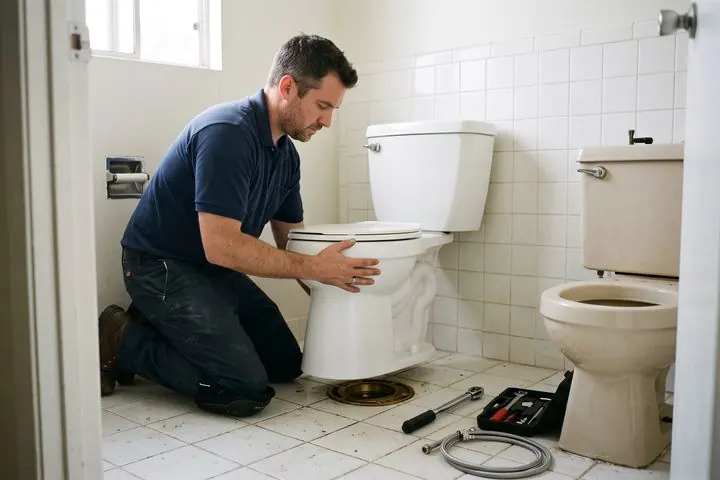
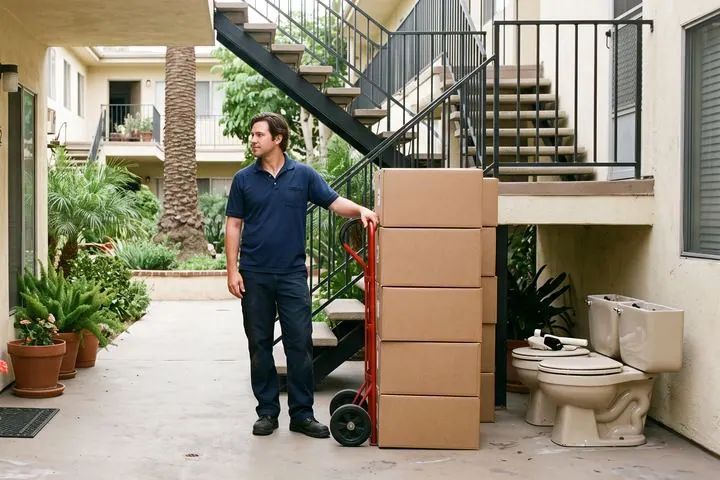
LADWP’s commercial rebate is $300 per toilet for multifamily buildings with five or more units. LADWP’s program requires replacing a toilet rated 1.6 GPF or higher with one rated 1.1 GPF or less. Planet Optima installs 0.9 GPF WaterSense fixtures, which use less water than the program requires. LADWP funding covers the fixture, licensed installation, and haul-away of the old unit. The owner pays nothing. Planet Optima handles the program end to end: eligibility check, pre-inspection, LADWP paperwork, scheduling, installation, post-inspection, and rebate processing.
Here is what it looks like on a 100-unit building:
| Item | Detail |
|---|---|
| Eligibility | 5+ units, LADWP water account, existing toilets 1.6 GPF or higher |
| Owner cost | $0 |
| Crew pace | Up to 50 toilets per day, about 20 minutes per unit |
| Owner effort | One authorization form |
| Estimated savings | About $25,000 per year in combined water and sewer at 2026 rates |
| Property value at a 5% cap rate | About $500,000 ($25,000 a year ÷ 0.05) |
The savings estimate uses about 10 HCF saved per toilet per year (below the measured average) and roughly 1.25 toilets per unit, at July to December 2026 rates: $10.885 per HCF for Schedule B Tier 1 water and $10.13 per HCF for sewer, billed on 93% of water use. That works out to 1,250 HCF × ($10.885 + 0.93 × $10.13), or about $25,400 a year, the same inputs the sewer rates guide uses. The method comes from the Planet Optima data registry, validated in April 2026 against 2020 to 2024 case study billing data. Your building’s number depends on fixture count, occupancy, and current fixture condition, which is why the assessment comes first. The full process, fixture specs, and FAQ are in the complete guide to LADWP’s toilet replacement program.
Not sure if your building qualifies?
We will help you figure it out. Send us your building details and we will check your exact eligibility, unit count, and savings projection.
Check Your Building’s EligibilityOne honest limit: this fixes the indoor side. If your exposure is a decorative lawn under AB 1572 or a sprinkler schedule that ignores the ordinance, you need a landscape contractor, not a plumber. Most LA apartment buildings have both problems. The indoor one is the only one somebody else pays for.
What to Do This Month
- Confirm your EBEWE status: Look up your Building ID cohort and put June 1 on the calendar if you are over 20,000 square feet.
- Walk the property for outdoor violations: Check watering days, run times, runoff, and turf. These are the fines that arrive first.
- Count the toilets: If they are 1.6 GPF or older and the building has five or more units, LADWP will pay to replace them.
Sewer rates step up again in July 2027. LADWP’s compliance clock starts January 1, 2027. The fixture program is funded as of September 2026.
Frequently Asked Questions
It is not a direct deadline for owners. January 1, 2027 is the date urban water suppliers such as LADWP must begin demonstrating compliance with their water use objectives under California's Making Conservation a Way of Life regulation. There is no separate state deadline for individual apartment owners. The pressure reaches buildings indirectly, through LADWP rates, enforcement, rebates, and reporting rules.
It is a permanent California regulation adopted by the State Water Resources Control Board on July 3, 2024 and effective January 1, 2025. It gives each urban retail water supplier an annual water use objective built from indoor residential use (47 gallons per person per day through 2029, then 42), outdoor use, and losses. Suppliers begin annual compliance demonstrations on January 1, 2027.
They do if the building is over 20,000 square feet. Los Angeles's Existing Buildings Energy and Water Efficiency ordinance requires annual whole-building energy and water benchmarking through ENERGY STAR Portfolio Manager, due June 1 each year, plus an audit or retro-commissioning every five years based on the last digit of the LADBS Building ID.
Yes. Under LADWP's water conservation ordinance, buildings with meters of two inches or larger receive a warning, then fines of $200, $400, and $600 for repeat violations. Under the unreasonable water use amendment, the highest-use properties can be placed on a property-specific water budget with penalties starting at $1,000 per month, rising to $4,000 per month in Phase 2 and up to $40,000 per month in Phase 5.
It can. AB 1572 bans irrigating nonfunctional turf with potable water on a phased schedule: commercial, industrial, and institutional properties from January 1, 2028, and HOA or common-interest-development common areas from January 1, 2029. Apartment properties with decorative turf in covered common areas should plan for it.
Yes. Under SB 407 a toilet is noncompliant only if it uses more than 1.6 gallons per flush. Multifamily and commercial properties were required to replace those fixtures by January 1, 2019. A 1.6 GPF toilet is legal, but it uses roughly 78 percent more water per flush than the 0.9 GPF fixtures Planet Optima installs through the LADWP program.
It is the indoor residential water use standard California suppliers must use when calculating their water use objectives from 2025 through 2029. It drops to 42 gallons per person per day starting January 1, 2030. It applies to suppliers, not to individual tenants, but it is the number LADWP is being measured against.
Buildings with five or more units in LADWP territory can use the LADWP-funded toilet replacement program. LADWP's program requires replacing a toilet rated 1.6 GPF or higher with one rated 1.1 GPF or less, and Planet Optima installs 0.9 GPF WaterSense fixtures. LADWP funding covers the fixture, installation, and haul-away, at no cost to the owner. Measured Planet Optima projects show 32 to 34 percent whole-building water reductions, which lowers water and sewer bills and improves EBEWE benchmarking scores.
Planet Optima's canonical estimate is about $25,000 per year in combined water and sewer savings for a 100-unit building at 2026 LADWP rates, based on measured billing data of roughly 10 HCF saved per toilet per year and about 1.25 toilets per unit. Savings vary by building, fixture condition, and occupancy.
Sources
- LADWP Water Conservation Ordinance (retrofit on resale, Ordinance 172075) Checked
- LA Ordinance 172075 (1998), water closet, urinal and showerhead regulations Checked
- LA Ordinance 180822 (2009), high-efficiency plumbing fixtures Checked
- State Water Board, Making Conservation a California Way of Life fact sheet Checked
- State Water Board, water efficiency legislation and regulation page Checked
- LADWP, Water Conservation Ordinance Checked
- LADWP News, unreasonable water use enforcement Checked
- LADBS, EBEWE audit and retro-commissioning FAQ Checked
- LADWP, Building Benchmarking Checked
- California Legislative Information, AB 1572 bill text Checked
- California Legislative Information, SB 407 bill text Checked
- LA Sanitation and Environment, sewer service charge Checked