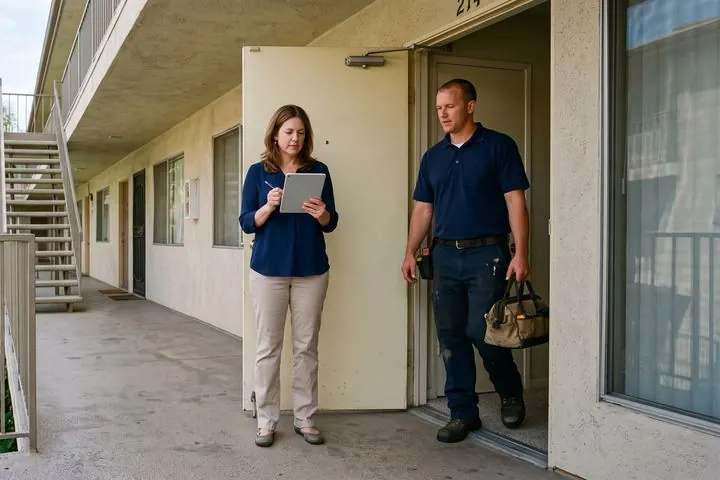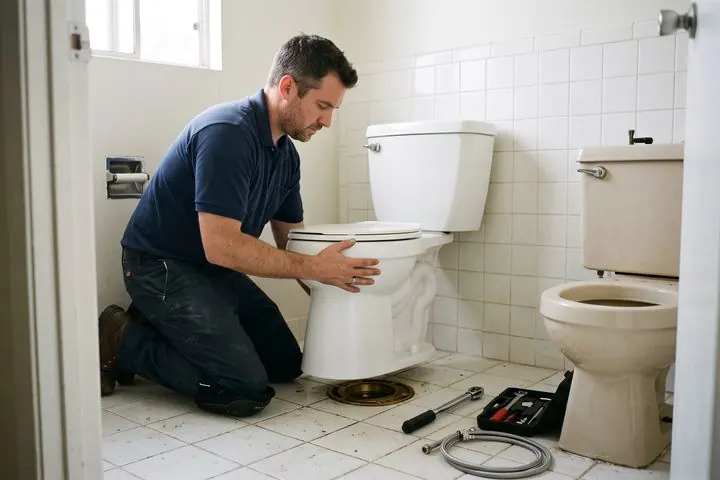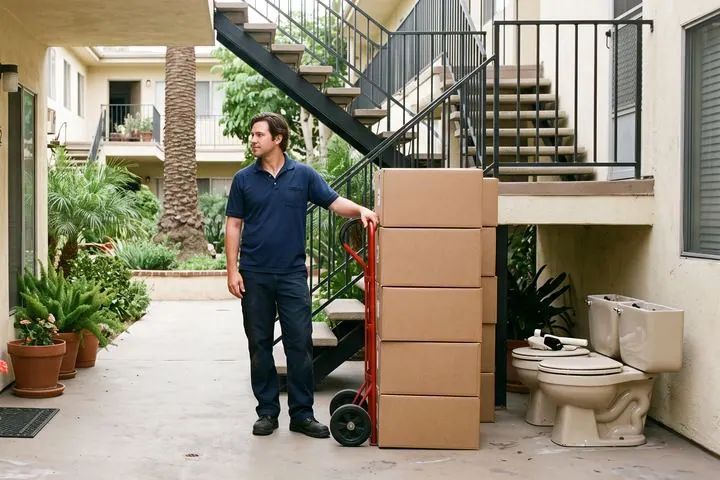

Planet Optima is a Los Angeles utility rebate implementation partner. It replaces toilets in multifamily buildings (5+ units) at no cost to the owner through LADWP’s commercial toilet rebate, and it has replaced 500,000+ toilets across Southern California in 15+ years.
Water conservation in Los Angeles is no longer seasonal. It’s permanent.
As of October 1, 2026, LADWP’s water conservation ordinance page lists the City of Los Angeles in Phase 2.
Between LADWP’s Phase 2 conservation ordinance, California’s permanent water efficiency regulation, AB 1572’s turf irrigation ban, EBEWE benchmarking requirements, and sewer rates that are doubling by 2028, apartment building owners face a convergence of rules, costs, and efficiency pressure that did not exist before 2024.
This article walks through what each of them means for a multifamily building.
What LADWP Requires Right Now: Phase 2 Conservation
LADWP’s Phase 2 Emergency Water Conservation Ordinance has been in effect since July 27, 2023. It applies to every LADWP customer, including apartment buildings.
Phase 2 rules:
- Outdoor watering limited to 3 days per week (odd addresses: Mon/Wed/Fri; even: Sun/Tue/Thu)
- All outdoor watering prohibited between 9 a.m. and 4 p.m.
- Sprinklers limited to one 8-minute cycle per station per watering day (two 15-minute cycles for water-conserving nozzles)
- No watering of hardscapes (sidewalks, driveways, parking areas)
- No runoff onto streets or gutters
- All leaks must be repaired in a timely manner
Phase 2 penalties by meter size:
| Violation | Meters 2 inches and larger | Meters under 2 inches |
|---|---|---|
| 1st | Written warning | Written warning |
| 2nd | $200 | $100 |
| 3rd | $400 | $200 |
| 4th | $600 | $300 |
| 5th | Flow restriction | Flow restriction |
A fifth violation brings a flow restriction, according to LADWP’s ordinance page.
LADWP’s Water Conservation Response Unit patrols neighborhoods and responds to waste complaints. Fines appear as charges on your water bill. Under the city’s Rent Stabilization Ordinance, landlords can pass 50% of conservation penalties to tenants as a temporary rent surcharge, which doesn’t improve tenant relations.
These are the current baseline rules. The more important shift is that California’s efficiency framework is now permanent, not temporary.
California’s Permanent Rule: A Supplier Deadline, Not a Building Deadline
On July 3, 2024, the California State Water Resources Control Board adopted the Making Conservation a Way of Life regulation. It took effect January 1, 2025.
This is not a drought-only measure. It’s permanent.
The regulation applies to urban retail water suppliers like LADWP, not directly to individual apartment owners. The timeline that matters is simple:
| Date | What happens | Who it applies to |
|---|---|---|
| January 1, 2025 | The rule took effect, and suppliers began calculating and reporting their urban water use objectives | Urban retail water suppliers |
| January 1, 2027 | Suppliers begin annual compliance demonstrations against those water use objectives | Urban retail water suppliers |
| For your building | There is not a separate January 1, 2027 compliance deadline | Apartment owners and managers |
That distinction matters. The building-level impact is indirect but real: LADWP has more reason to push conservation through tools it already uses, including education and outreach, leak detection, rebates, direct installation programs, benchmarking pressure, and local enforcement. The indoor residential standard is 47 gallons per capita per day from 2025 through 2029 (dropping to 42 on January 1, 2030), which is why efficient fixtures matter more now.
The 47-GPCD standard is not abstract. Old toilets rated at 1.6 GPF use about 78% more water per flush than the 0.9 GPF models Planet Optima installs through the LADWP commercial rebate program. On a multifamily property, that fixture gap can add up fast.
AB 1572: The Turf Rules to Watch
Assembly Bill 1572, signed in October 2023, bans irrigating nonfunctional turf with potable water on a phased timeline:
| Deadline | Properties Affected |
|---|---|
| January 1, 2027 | State and local government properties |
| January 1, 2028 | Commercial, industrial, and institutional properties |
| January 1, 2029 | HOA common areas and community organizations |
Nonfunctional turf means decorative grass that nobody uses for recreation. For many apartment owners, this is a secondary issue unless the property has ornamental turf in common areas or falls into a covered property classification.
Penalties: Noncompliance can cost up to $1,000 per day. Commercial, industrial, and institutional properties with more than 5,000 sq. ft. of irrigated area must certify compliance to the State Water Board every three years starting June 30, 2030 (June 30, 2031 for HOA common areas).
AB 1572 is mainly an outdoor-landscape issue. The more immediate pressure for most apartment buildings is still Phase 2 enforcement plus the cost of indoor water waste.
EBEWE: Annual Water Reporting for Large Buildings
The Existing Buildings Energy and Water Efficiency (EBEWE) ordinance requires buildings over 20,000 sq. ft. in Los Angeles to benchmark and report water usage annually. Covered buildings also owe an audit or retro-commissioning every five years, on a schedule set by the last digit of the LADBS Building ID. The California water compliance guide for LA apartments lists which Building IDs are due in 2026 and 2027.
If your building is large enough for EBEWE, replacing inefficient toilets directly improves your benchmarking numbers, with an eligible fixture change that can require no capital outlay through LADWP’s toilet replacement program.
Not sure if your building qualifies?
We will help you figure it out. Send us your building details and we will check your exact eligibility, unit count, and savings projection.
Check Your Building’s EligibilityHighest-Use Penalties: $1,000-$4,000/Month in Phase 2
Separate from the Phase 2 watering fines, LADWP has an unreasonable water use enforcement program targeting the city’s highest water users. Properties identified as unreasonable users receive an onsite analysis, a customer conservation plan, and a monthly water budget.
Under the rules LADWP published for the Phase 2 environment, penalties begin at $1,000 per month and can rise to $4,000 per month for continued noncompliance. The often-cited $40,000 per month ceiling applies only under much stricter Phase 5 conditions.
LADWP’s October 2016 enforcement announcement said single-family customers who reach Tier 4 pricing may be contacted for an onsite review. LADWP starts with education, rebates, and incentives before imposing penalties. But the enforcement mechanism is real, and high-usage properties can be forced onto a building-specific conservation plan.
Rising Costs Make Conservation a Financial Decision Too
Conservation isn’t just about compliance. It’s about money.
LADWP sewer rates are doubling, from $5.80/HCF in 2024 to $11.96/HCF by July 2028. A 100-unit building’s annual sewer bill goes from about $42,000 in 2024 to about $87,000 by July 2028. Every gallon wasted by an old toilet gets billed twice: once as water, again as sewer at 93% of usage.
The regulatory pressure and the financial pressure point in the same direction: reduce indoor water consumption.
The LADWP-Funded Indoor Fix: Toilet Replacement
For eligible multifamily properties, the LADWP commercial toilet rebate can cover a high-impact indoor water conservation upgrade with no capital outlay from the owner.
The program:
- Eligible multifamily properties with 5+ units can use LADWP’s $300-per-toilet commercial rebate (the LADWP toilet rebate amounts explainer covers how it differs from the $40 and $250 figures)
- LADWP requires replacing 1.6+ GPF toilets with models rated 1.1 GPF or less; Planet Optima installs 0.9 GPF WaterSense-certified fixtures
- Up to 50 toilets per day, ~20 minutes per unit, professional licensed crews (CSLB License #1042932)
- You send one form, and eligibility, paperwork, scheduling, installation, and rebate processing are handled for you
- 500,000+ toilets replaced across Southern California in 15+ years
The math:
| Building Size | Annual Savings | Property Value Added (5% cap rate) |
|---|---|---|
| 20 units | ~$5,000 | ~$100,000 |
| 50 units | ~$12,500 | ~$250,000 |
| 100 units | ~$25,000 | ~$500,000 |
| 200 units | ~$50,000 | ~$1,000,000 |
Savings include both water and sewer charge reductions and are planning estimates that vary by building, fixture mix, and current rate assumptions. They assume about 1.25 toilets per unit and roughly 10 HCF saved per toilet per year from measured billing data, and property value is the annual savings divided by a 5% cap rate.
Toilet replacement does not solve outdoor turf rules, but it materially helps on the indoor side of the problem: lower water use, lower sewer charges, stronger benchmarking performance, and less exposure to waste from outdated fixtures.
Read the complete guide to LADWP’s toilet replacement program →
What to Do Now
Phase 2 is still active as of October 1, 2026. The sewer-rate increases are still locked in through 2028. And LADWP still offers an indoor-efficiency path eligible apartment owners can act on now.
Check your building’s eligibility with one form, or start with the full LADWP sewer rate breakdown and the complete toilet replacement guide.
Frequently Asked Questions
As of October 1, 2026, apartment buildings served by LADWP are under Phase 2: outdoor watering limited to 3 days per week, no sprinkler watering between 9 a.m. and 4 p.m., 8-minute sprinkler limits per station, and no runoff or hardscape watering. For meters 2 inches and larger, penalties escalate from a written warning to $200, $400, and $600, then a flow restriction on a fifth violation.
Yes. Under the Phase 2 conservation ordinance, apartment buildings with larger meters face fines of $200 (second violation), $400 (third), and $600 (fourth). Under LADWP's unreasonable water use program, the city's highest users can also be placed on a property-specific water budget. In Phase 2, those penalties run from $1,000 to $4,000 per month. The $40,000 per month figure is the Phase 5 ceiling.
It is a permanent California regulation, effective January 1, 2025. It applies to urban retail water suppliers, not individual apartment owners directly. January 1, 2027 is when suppliers begin annual compliance demonstrations against their water use objectives, including the 47 gallons per capita per day indoor standard used from 2025 through 2029. There is not a separate January 1, 2027 deadline for apartment owners, but LADWP has more reason to push conservation through rates, stricter enforcement, and expanded conservation programs.
Yes, buildings over 20,000 sq. ft. in Los Angeles must benchmark and report water usage annually under the Existing Buildings Energy and Water Efficiency (EBEWE) ordinance. Efficient fixtures help those scores, and toilet replacement through the LADWP program can improve benchmarking without capital outlay.
For eligible multifamily buildings with 5+ units, the LADWP commercial rebate can cover approved toilet replacement costs. The $300 rebate pays toward fixtures, installation, and removal. That does not replace every conservation rule, but it directly reduces indoor water waste, sewer costs, and exposure tied to outdated fixtures.
AB 1572 bans potable-water irrigation of nonfunctional turf. Commercial, industrial, and institutional properties are covered starting January 1, 2028, and HOA or common-interest-development common areas starting January 1, 2029. It matters most if your property has decorative turf in a covered common area or mixed-use classification.
A 100-unit building is commonly modeled at approximately $25,000 per year in combined water and sewer savings under Planet Optima's planning methodology, which assumes about 1.25 toilets per unit and roughly 10 HCF saved per toilet per year. Actual savings vary by building and usage, but the sewer-charge reduction materially increases the impact.
Sources
- LADWP, Water Conservation and Ordinance (Phase 2 rules and penalties) Checked
- LADWP News, LADWP Customers Go Back to Three-Days-A-Week Watering (Phase 2 effective July 27, 2023) Checked
- LADWP News, LADWP to Begin Enforcement of Unreasonable Water Use Ordinance on City's Top Water Users Checked
- Los Angeles Municipal Code Section 151.06.2, Surcharge for Water Conservation Assessment
- State Water Resources Control Board, Making Conservation a California Way of Life Checked
- State Water Resources Control Board, Making Conservation a California Way of Life final regulation text Checked
- California Legislature, AB 1572 bill text Checked
- California Water Code Section 1846 (civil liability of up to $1,000 per day) Checked
- LADWP, Building Benchmarking (EBEWE) Checked
- LADBS, EBEWE Audits and Retro-Commissioning FAQs
- LADWP, Commercial Sewer Service Charge Checked
- LADWP, Commercial SoCal Water$mart Rebate Program Checked